


Preparing for software engineering interviews at FAANG and top-tier tech firms often devolves into a grueling, inefficient cycle: solving hundreds of isolated LeetCode challenges, memorizing tricky edge cases, and hoping the interviewer asks a question you have already seen. However, when presented with a slight variation during a live exam, candidates frequently freeze.
The industry-leading course on Educative.io, “Grokking the Coding Interview: Patterns for Coding Questions,” fundamentally changes this approach. Instead of treating algorithm preparation as a rote-memorization marathon, it teaches software engineers how to identify underlying algorithmic structural patterns.
In this detailed review, we explore why this pattern-recognition framework has become an industry standard, how its video-free format speeds up learning, and how to apply its visual mental models during live coding rounds.
1. Paradigm Shift: Memorization vs. Pattern Recognition
Traditional technical interview preparation relies on brute-force problem volume. In contrast, pattern-based learning focuses on identifying core data structure transformations that solve entire categories of problems simultaneously.

2. Core Algorithmic Patterns Covered
The course systematically builds competence across essential patterns frequently tested in technical rounds:
- Sliding Window: Used for contiguous subarrays or substrings to reduce time complexity from $\mathcal{O}(N \times K)$ or $\mathcal{O}(N^2)$ down to linear $\mathcal{O}(N)$ time.
- Two Pointers: Essential for searching pairs, triplets, or elements in sorted arrays or linked lists without additional space allocations.
- Fast & Slow Pointers: Also known as Floyd’s Tortoise and Hare algorithm; primary choice for detecting cycles in linked lists or cyclic arrays.
- Merge Intervals: A robust pattern for handling overlapping time slots, calendar scheduling, and interval union problems.
- Tree BFS & DFS: Structured approaches for level-order traversals, depth tracking, and path finding in hierarchical tree/graph structures.
- Top ‘K’ Elements: Leveraging Min-Heaps and Max-Heaps to quickly isolate extreme values or frequencies in constant/logarithmic time bounds.
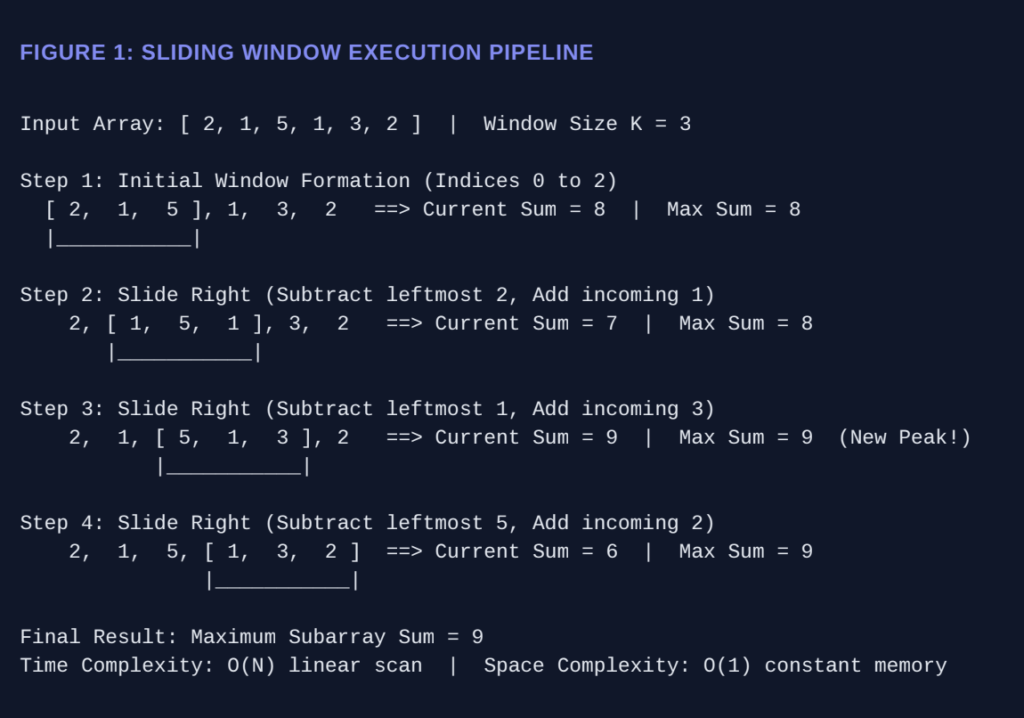
3. Visual Execution Scheme: The Sliding Window Archetype
To demonstrate how Educative visually decomposes complex operations, consider the step-by-step trace of the Sliding Window pattern finding the maximum sum of a contiguous subarray of size $K = 3$:
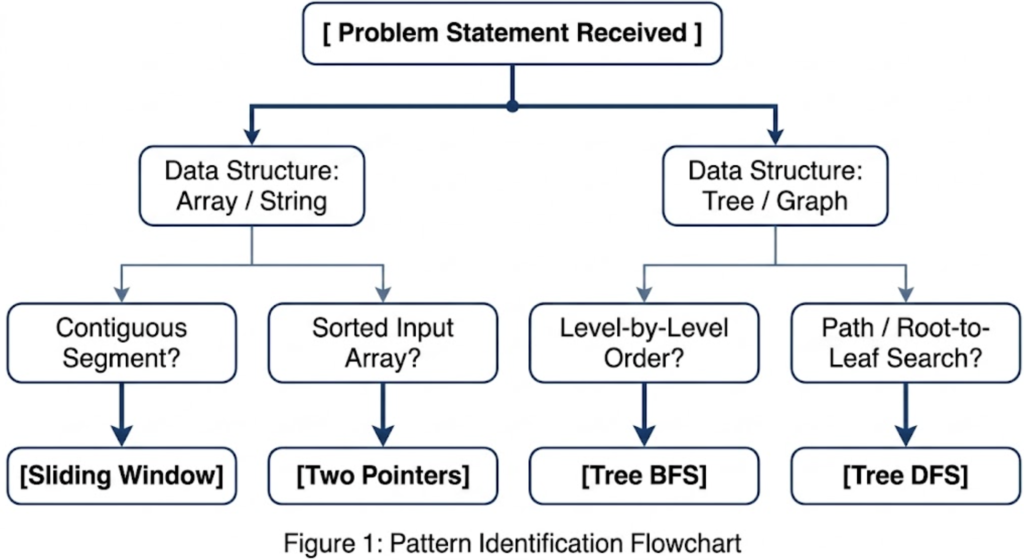
4. Architectural Decision Tree for Interview Problem Solving
During a high-pressure interview, speed of problem categorization is critical. The course instills an immediate analytical decision process mapped out below:
5. Why Text-Based Interactive Learning Outperforms Video
Educative.io distinguishes itself through a purely text-based, interactive learning architecture designed specifically for developer productivity:
- 3x Faster Consumption: Reading technical documentation and code snippets is significantly faster than scrubbing through video timelines.
- Embedded In-Browser Sandbox (IDE): Execute Python, C++, Java, JavaScript, or Go directly within the lesson without setting up local development environments or compilers.
- Instant Code Modifications: Practice modifying test cases and edge constraints in real time with instant output feedback.
Final Verdict & Practical Takeaway
“Grokking the Coding Interview” remains the premier recommendation for software engineers aiming for top-tier tech roles. By shifting focus from sheer problem quantity to deep structural mastery, candidates can cut their interview preparation time in half while drastically improving their problem-solving resilience during live coding rounds.
If your goal is to approach coding rounds with structured confidence rather than guessing games, this course is an invaluable investment.
Access the official course here: Grokking the Coding Interview: Patterns for Coding Questions on Educative.io